Your Clients Already Know What They Want. AI Is the First Time They Can Show You
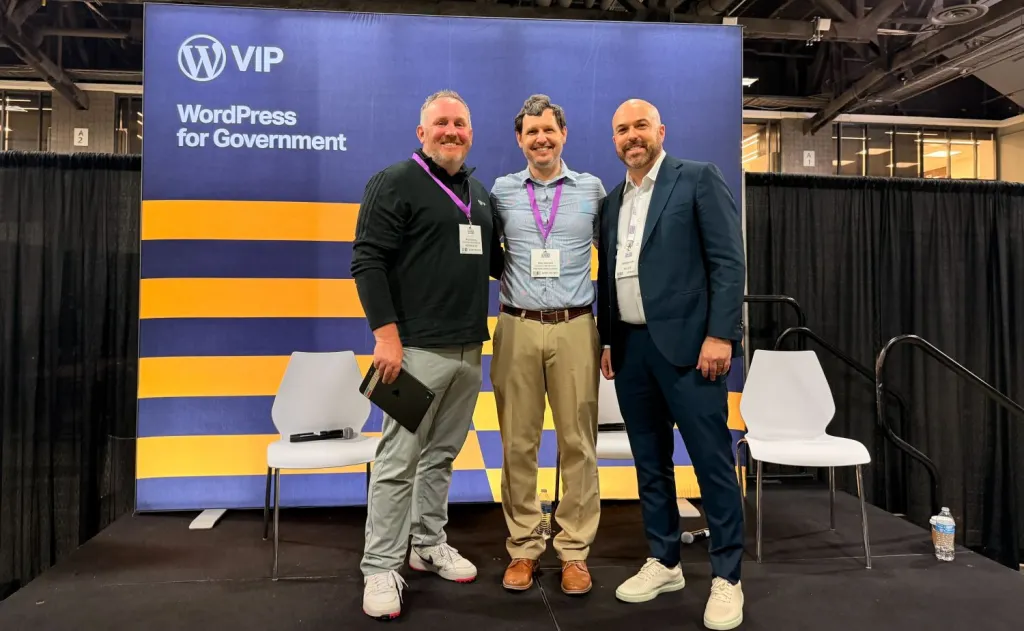
A few weeks ago, I joined a roundtable at the Government Service Delivery 2026 conference in Washington, D.C., alongside practitioners from WordPress VIP and Vast Design and Development. The session was nominally about the US Web Design System (USWDS) and how agencies are implementing it across constrained environments. But the conversation that stuck with me wasn’t really about design systems at all.
It was about what happens when a client walks into a kickoff meeting having already built what they want.
That’s new. And for marketing and communications leaders investing in digital work, it changes the conversation in ways that are worth understanding.
The Brief Is No Longer a Document
One of the most significant shifts I’ve seen in the last year is that clients are now arriving with AI-generated prototypes of their own projects. They’ve used tools like Claude to spin up a visual approximation of what they’re looking for – vibe coding – and they bring that artifact into the first meeting.
This is genuinely useful. It collapses the extraction problem that has always been the most expensive part of a digital engagement. Getting a client to successfully articulate what they want from a website has historically taken weeks of workshops, wireframes, and revision cycles. A working prototype, even a rough one, communicates intent faster than any written brief.
Clients are now able to communicate a more complete vision of what they’re looking for right out of the gate, in a visual way that makes the back and forth between engineering and design a lot easier.
The implication for senior marketing leaders is worth sitting with. If your team or your agency partners are still running lengthy discovery processes to establish what good looks like, there’s a faster path available. AI-generated prototypes are not the final product. But, as a communication tool for aligning stakeholders before engineering begins, they’re a significant accelerant.

Speed and Compliance Aren’t Actually in Tension if You Architect it Right
The roundtable was ostensibly about USWDS because that’s the context of government digital delivery: a mandatory design standard that agencies are expected to implement across wildly different resource environments. But the underlying question applies to any organization operating under strict compliance obligations: how do you move fast without breaking things that matter?
The answer we kept returning to is component-based architecture. When your accessibility standards are baked into the components themselves, speed and compliance stop competing with each other. You’re not choosing between meeting a deadline and meeting a standard. You’re building with components that satisfy both by default.
At WDG, we’ve built a proprietary framework called Wikit, a library of accessible, reusable WordPress blocks designed for enterprise-scale digital builds. The logic is the same as USWDS: if the components are right, the pages composed from them are right. The quality lives upstream, not in a final audit.
AI accelerates this further. We now use AI throughout the build process – to evaluate whether a component meets accessibility standards before it ships, to speed up testing and remediation cycles, to help engineers work through the Gutenberg block architecture that WordPress requires. What used to be a day of work is sometimes an hour. That changes what’s realistic for constrained budgets and compressed timelines.
Automation Still Needs an Owner
The closing question at the roundtable was the most practical one: if you could hand one tool or one habit to a constrained team just starting a USWDS implementation, what would it be?
My answer was a habit instead of a tool: assign ownership.
Not ownership of the technology. Ownership of the process, end to end, from design decisions through post-launch audits. Someone whose job it is to make sure the design system is actually adhered to, that accessibility standards don’t slip between design and delivery, that the work that went into building the right foundation isn’t quietly undermined by the first batch of new content.
With all the AI advancements and buzzwords, it’s easy to get lost in the sauce. Having someone who’s truly watching over and owning the whole process is the most important way to impact the final delivery.
This matters more now, not less. AI is capable of producing significant output quickly: code, components, copy, entire page builds. But the speed is precisely why accountability becomes more important. Someone has to be responsible for what ships. Automated testing catches roughly half of accessibility issues; keyboard testing and screen reader testing catch the rest. AI can help with both, but it can’t replace the human judgment that determines whether something is actually done.
The organizations that will get the most out of AI-assisted development are the ones that combine capability with accountability: using the tools to move faster, while keeping a human who owns the outcome.
What This Means For How You Invest in Digital Work
For senior marketing and communications leaders, the practical takeaway from this conversation is a reframe of where the leverage is in a digital engagement.
The question used to be: how do we communicate what we want clearly enough that a team can build it? The answer to that question is now faster and cheaper than it’s ever been. AI-generated prototypes, AI-assisted specification, AI-accelerated development all make the build faster.
The question that still requires organizational investment is: who owns this? Who is watching the whole process, holding the standard, making sure that what ships actually reflects the strategy behind it?
This is a question for leadership and it’s the one that tends to determine, more than anything else, whether the investment in a digital project produces something that actually works.
Watch Doug Axelrod at Government Service Delivery, 2026 alongside WordPress VIP and Vast Design.